The methodRaJA STREAM
Learning becomes meaningful when it is self-directed.Learning begins when a child genuinely wants to know.
RaJA STREAMRaJA STREAM is not a curriculum in which adults deliver predetermined knowledge in a fixed order.
It is a way of learning that begins with questions discovered through play and everyday life. Children observe, predict, investigate, experiment, create, and communicate for themselves.
The six areas of STREAM are not separate subjects into which children’s learning must be divided. They are six lenses through which one question can be explored more deeply.
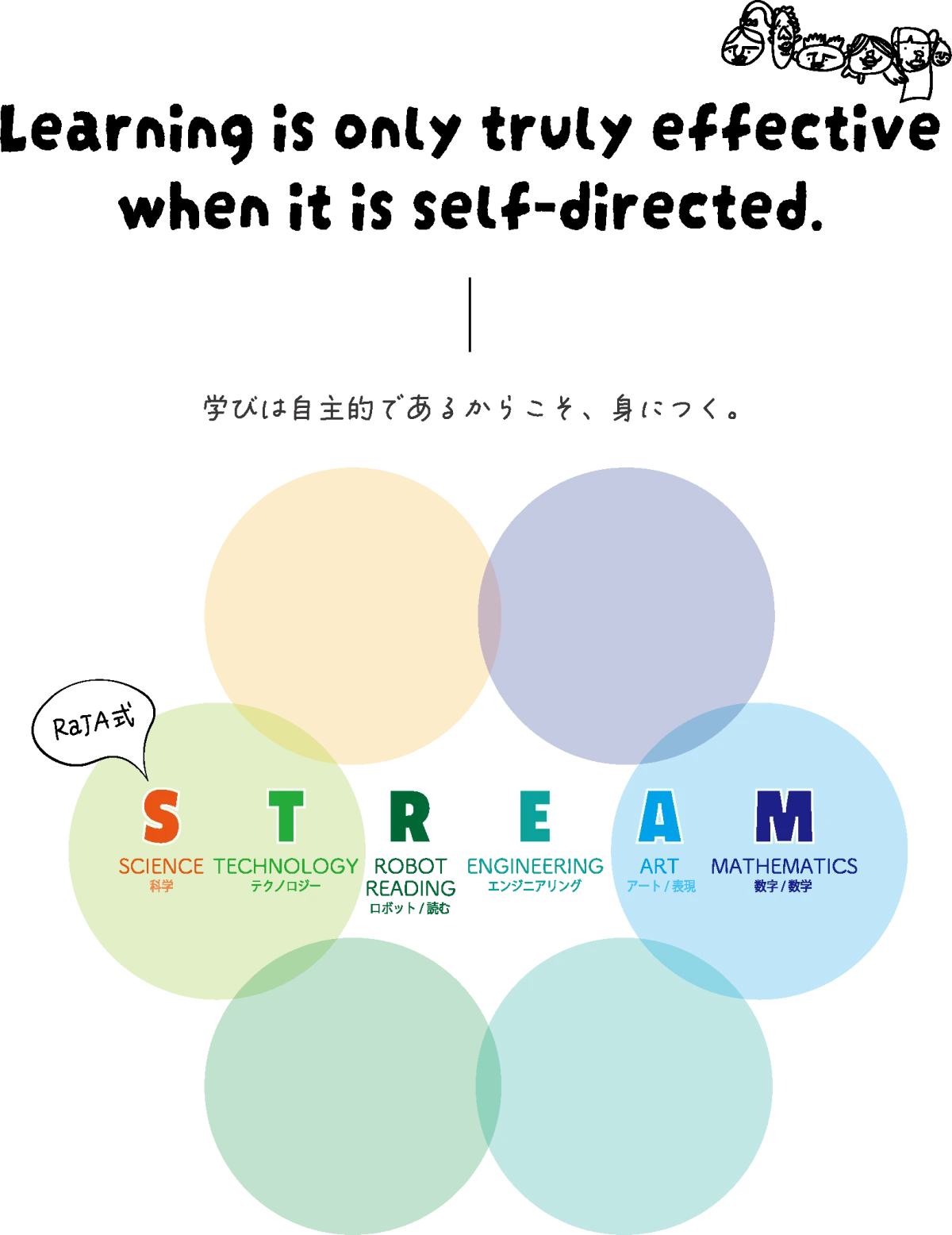
- SScienceScience
Observe, question, and investigate.
Children notice nature and everyday phenomena, form their own questions, and explore change and cause through prediction and experimentation.
- TTechnologyTechnology
Use tools and systems to expand possibilities.
Technology includes more than digital devices. Children select and use everyday tools purposefully to gather information and turn ideas into action.
- RRobot / ReadingRobotics and reading
Read meaning, order, patterns, and relationships.
Children gather information from stories and reference materials and consider sequences and connections. They also develop the logical thinking that supports robotics and programming.
- EEngineeringEngineering
Imagine, build, test, and improve.
Children consider the form or structure needed for a purpose, create it, test it, and use what did not work as information for their next design.
- AArtArt and expression
Communicate what you feel in your own way.
Through colour, form, sound, movement, and language, children enjoy expression without a single correct answer and encounter perspectives different from their own.
- MMathematicsNumber and mathematics
Compare, count, and discover patterns.
Children experience quantity, size, shape, order, and relationships through meaningful activity and develop the ability to think logically.
One question can open an ocean of learning.
Imagine a child asks, “How can we make a boat that floats?”
- ScienceObserve which materials float or sink
- TechnologySelect suitable tools and materials
- Robot/ReadingFind information and organise the steps
- EngineeringDesign, build, test, and improve the boat
- ArtChoose colours and forms to create a unique design
- MathematicsCompare length, weight, quantity, and balance
We do not force all six lenses into every activity.
As children follow their questions, relevant perspectives overlap naturally and learning expands beyond the boundaries of traditional subjects.
IB PYP × RaJA STREAM
A framework for inquiry and six lenses for understanding the world.
As an IB PYP candidate school, we value learning that begins with children’s questions and develops into reflection and meaningful action.
IB PYP provides a framework through which children form questions, inquire, reflect, and act. RaJA STREAM offers six lenses through which those questions can be explored from different directions.
They are not two separate curricula.
They meet around each child’s “Why?” and nurture both the agency to direct one’s own learning and the ability to understand a complex world through connections.
THE ENVIRONMENT AS THE THIRD TEACHER「環境」が育てる
We do not fill children with answers. We create an environment in which questions can emerge.
At RaJA, teachers do not determine every course children must follow.
We prepare materials children want to touch, tools they want to test, time in which they can pause and think, and opportunities to exchange ideas with companions who see the world differently.
Teachers observe children carefully, document the learning process, and offer questions or guidance when support is genuinely needed.
Rather than leading children immediately to the correct answer, we protect the time they need to discover for themselves.
Because children have questioned, chosen, and experimented through their own initiative, learning becomes deeply rooted as a capability they truly own.