RaJA Global Academy

学習塾・小学受験対策

Small, semi-individual tutoring built on RIT — RaJA’s own method for intellectual and moral development.

How it works学びを確かなものに

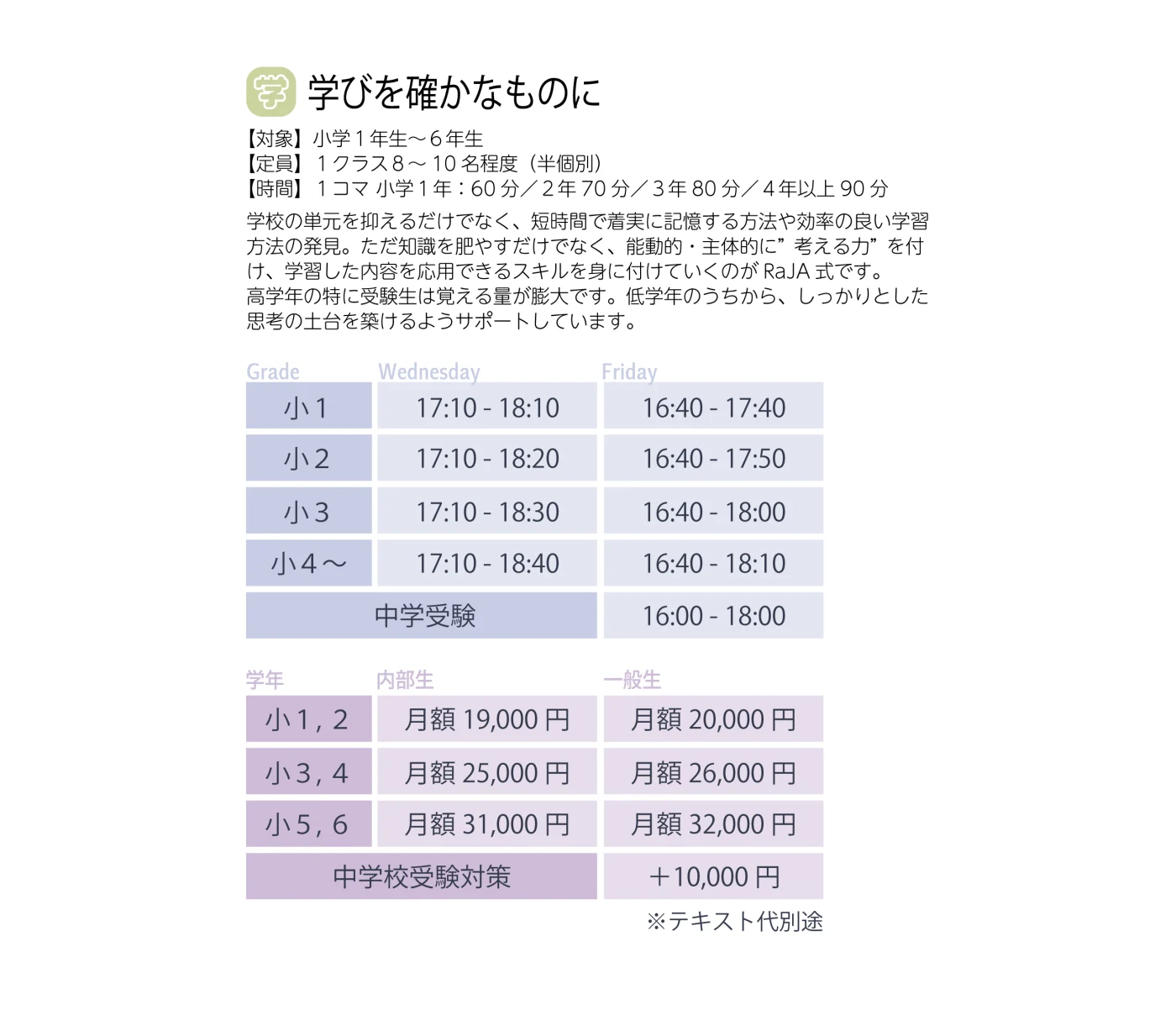
Tutoring (primary years 1 to 6)
Class sizeAbout 8 to 10 per class, taught semi-individually
Lesson lengthYear 1: 60 min · year 2: 70 min · year 3: 80 min · year 4 and up: 90 min
Timetable
YearWednesdayFriday
Primary 117:10 – 18:1016:40 – 17:40
Primary 217:10 – 18:2016:40 – 17:50
Primary 317:10 – 18:3016:40 – 18:00
Primary 4+17:10 – 18:4016:40 – 18:10
Secondary entrance—16:00 – 18:00

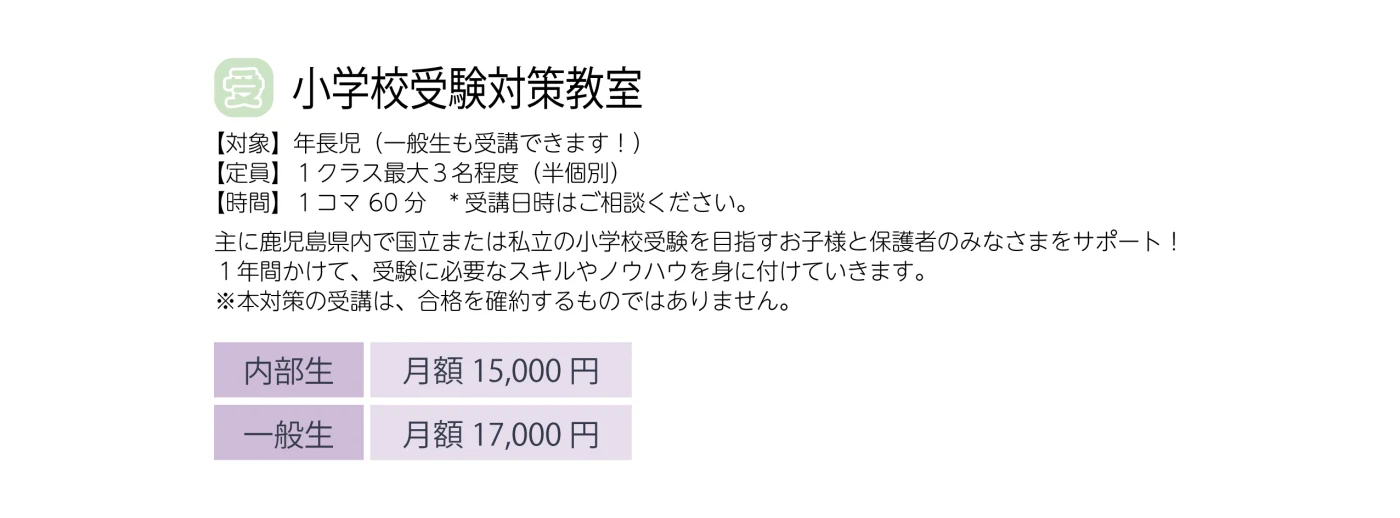
Entrance preparation小学校受験対策教室

Who it is forAge 5 (children from outside the school are welcome)
Class sizeAt most about 3 per class, taught semi-individually
Lesson length60 minutes — the day and time are arranged with you

Taking this course does not guarantee a place at any school.

The fees are on the fees page

The postersくわしいご案内

More ways to think. More ways to navigate life.

  • “I have seen this before.”
  • “I remember hearing about this.”
  • “I have tried something similar.”

Experiences gathered during early childhood may not immediately appear as answers. They remain within a child as drawers of thought that can be opened later.

When children encounter an unfamiliar question or situation, these drawers help them connect what they already know, consider different possibilities, and choose a way forward.

RIT is RaJA’s original educational method based on what is commonly known as right-brain education. It increases the range of experiences and ways of thinking available to children so that they can navigate life with greater confidence and flexibility.

RITとはWhat is RIT?
Creating drawers of thought that can support the future self.

Young children absorb what they see, hear, touch, feel, and experience, even before they can fully explain its meaning.

Through RIT, they encounter language, number, shape, colour, sound, movement, stories, and relationships in enjoyable and meaningful ways.

Immediate understanding or reproduction is not the only goal. An experience that appears to be a single point today may connect with another experience later.

  • “I know something about this.”
  • “This reminds me of something I did before.”
  • “Perhaps I could try it this way.”

When those points connect, children can use what is already within them to think, choose, and act.

RIT does not simply increase the number of answers children can memorise. It increases the number of drawers they can open when life asks them to think.

「生きやすくなる」とはWhat does it mean to make life easier to navigate?
It does not mean creating a life without difficulty or failure. It means being able to:

  • Consider another approach when something does not go as planned
  • Use previous experiences in an unfamiliar situation
  • Understand and communicate personal feelings
  • Imagine a perspective different from one’s own
  • Pause, regulate, and try again

The more drawers of thought children develop, the more possible responses and choices become available to them.

We believe that this range of choices can help children navigate their future lives with greater flexibility and confidence.
5つの思考の引き出しFive drawers of thought

RIT develops interconnected ways of thinking through Heart, Word, Logic, Creativity, and Body.

These areas do not grow separately. What a child feels can become language, thought, imagination, and action.

Heart — Drawers for understanding feelings, considering others, making personal choices, and turning thought into action.Word — Drawers for connecting knowledge with language and communicating thoughts through words and actions.Body — Drawers for sensing, regulating, coordinating, and using the body as a foundation for learning and action.Logic — Drawers for organising information, recognising number, order, patterns, relationships, and cause and effect.Creativity — Drawers for imagining what cannot yet be seen, approaching something from different directions, and discovering alternative possibilities.
Tap a part of the heart to jump to it.
  • Heart

    Think for yourself and turn thought into action.

    Children learn to recognise their emotions, care about others, and accept perspectives different from their own.

    By considering “What do I want to do?” and taking a personal next step, they develop agency, cooperation, patience, resilience, and the courage to try.

  • Word

    Turn thoughts into language and communicate them to others.

    Children think through language and develop language through thinking.

    Songs, stories, conversation, reading aloud, and writing nurture more than vocabulary and reading comprehension. They help children organise their ideas and communicate them meaningfully.

  • Body

    Sense, regulate, and move.

    The body provides an essential foundation for every kind of learning.

    Fine-motor activities, whole-body movement, rhythm, balance, and breathing help children understand and control their bodies for different purposes.

    We value both active movement and the ability to settle and regain calm.

  • Logic

    Compare, connect, and reason.

    Children encounter number, shape, sequence, patterns, and cause and effect through real objects and hands-on experiences.

    Rather than memorising repeated answers, they learn to observe, classify, predict, and explain the reasoning behind their ideas.

  • Creativity

    Imagine what cannot yet be seen and give it form.

    Children explore colour, shape, size, direction, position, distance, and perspective in multiple ways.

    Drawing, making, movement, and storytelling encourage them to ask, “Could there be another way?” and transform their ideas into original expression.

RIT-based academic learning

RITを応用した学習塾

Beyond remembering answers—learning how to reach them.

RaJA’s academic learning programs apply the RIT concept of drawers of thought to school learning and entrance preparation.

Children consider:

  • What they already know
  • Where their understanding became uncertain
  • Which knowledge may help
  • Whether another method is possible
  • How learning can be applied to a new question

Rather than progressing only according to school year, we identify each learner’s current stage and the methods through which they learn most effectively.

Academic Support

For
Grades 1–6
Format
Semi-individual instruction in groups of approximately 8–10

Children consolidate school learning while developing effective learning strategies and the ability to apply knowledge independently.

Primary-School Entrance Preparation

For
Final kindergarten year
Format
Semi-individual instruction in groups of up to three

Children practise more than solving examination questions. They develop listening, independent thinking, communication, and the ability to respond calmly in unfamiliar situations.

Participation does not guarantee admission to a particular school.

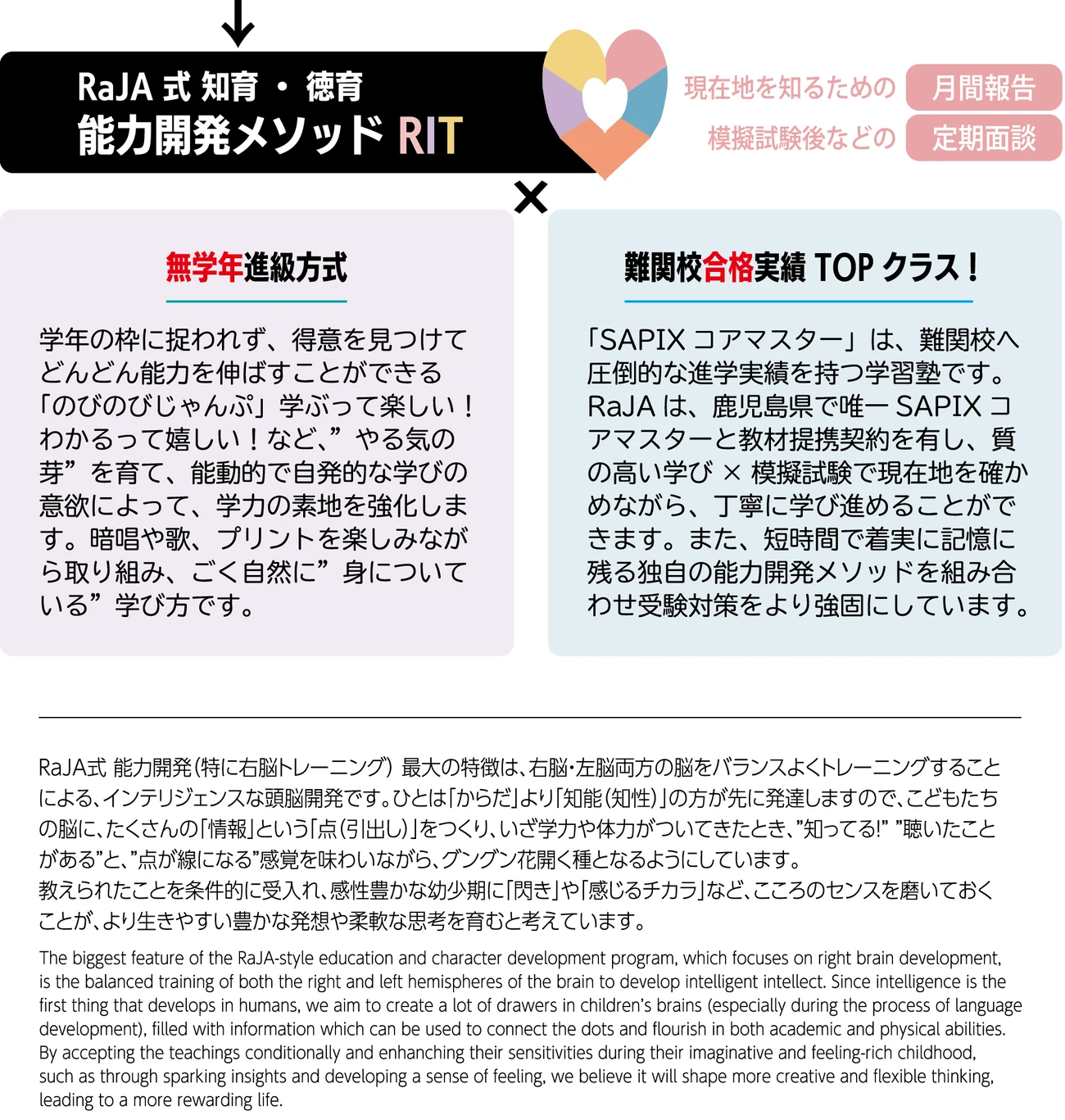
A band for RaJA’s intellectual and moral development method, RIT, with monthly reports that show where a child is now and regular meetings after mock tests. Below it, two panels: the non-year-graded progression system, which lets children grow their strengths without being held to their year group, and top-tier results, explaining that RaJA is the only school in Kagoshima Prefecture with a teaching-material partnership with SAPIX Core Master. Last, a passage in Japanese and English on RaJA’s method of training the right and left brain in balance.
  • Detail of the tutoring programme. For primary years 1 to 6, about 8 to 10 per class taught semi-individually, lessons from 60 minutes in year 1 to 90 minutes from year 4. It carries the Wednesday and Friday timetable by year group, and the monthly fees for enrolled and outside children.
  • Detail of the primary-school entrance preparation class. For 5-year-olds, including children from outside the school; at most about 3 per class, taught semi-individually, 60 minutes a lesson. It supports children and parents through a year of preparing for national or private primary-school entrance within Kagoshima Prefecture.

Tap any image to enlarge it. The posters are in Japanese.